

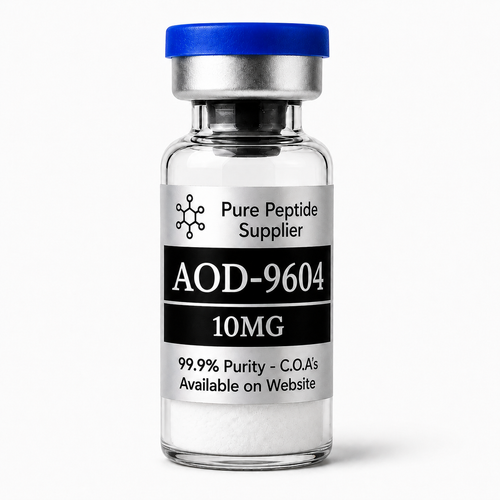
AOD-9604 Research Overview
Overview
AOD-9604 is a synthetic peptide fragment corresponding to amino acid residues 177–191 of the 191-amino-acid human growth hormone (hGH) molecule. The peptide was developed based on structure-function studies indicating that the C-terminal region of growth hormone may be responsible for its metabolic effects, including lipolytic activity, while the N-terminal region mediates its growth-promoting and proliferative effects. This structural distinction provided the scientific rationale for investigating whether the metabolic properties of growth hormone could be dissociated from its growth-promoting activities.
The C-terminal fragment was of particular interest because it appeared to retain lipolytic activity while demonstrating significantly reduced affinity for the growth hormone receptor and minimal IGF-1-stimulating capacity. Laboratory investigations have examined AOD-9604's effects on lipid metabolism, including the breakdown of stored triglycerides in adipose tissue and inhibition of de novo lipogenesis. Animal studies have reported that administration of AOD-9604 is associated with increased fatty acid oxidation and reduced fat accumulation under specific experimental conditions.
The peptide's mechanism of action appears to involve interactions with signaling pathways distinct from those activated by full-length growth hormone. While intact hGH exerts its effects primarily through the growth hormone receptor, activating JAK-STAT signaling cascades and stimulating IGF-1 production, AOD-9604 is believed to influence metabolic pathways through alternative mechanisms that remain incompletely characterized.
The current body of evidence consists primarily of preclinical investigations and a limited number of human clinical studies. Early-stage human research has examined the peptide's effects on body composition, lipid profiles, and metabolic biomarkers under controlled study conditions. However, the overall volume of clinical data remains limited compared with the extensive literature on intact growth hormone, and additional research is necessary to further characterize its pharmacology and biological activity.
Key Scientific Characteristics
Synthetic peptide fragment corresponding to hGH amino acid residues 177–191
Developed to investigate whether the metabolic effects of growth hormone could be dissociated from its growth-promoting activities
Demonstrates significantly reduced affinity for the growth hormone receptor compared with intact hGH
Does not stimulate IGF-1 production to the same degree as full-length growth hormone
Investigated for its influence on lipid metabolism, adipocyte biology, and fatty acid oxidation
Current evidence derived primarily from preclinical research and limited human studies
Proposed mechanisms of action remain incompletely characterized
Not approved by the U.S. Food and Drug Administration for therapeutic use
Research Notes
The scientific rationale for AOD-9604 research is based on structure-function studies of the growth hormone molecule that identified distinct domains responsible for metabolic and growth-promoting activities. Preclinical studies have reported effects on lipid metabolism and adipocyte function under experimental conditions, although the translation of these findings to human physiology remains incompletely characterized.
Published clinical data on AOD-9604 are limited compared with the extensive literature on intact growth hormone. Additional randomized controlled studies are required to further evaluate the pharmacological properties, biological activity, and long-term safety profile of AOD-9604.