

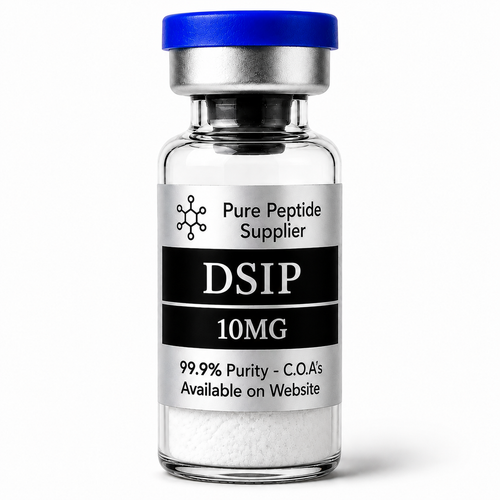
DSIP (Delta Sleep-Inducing Peptide) Research Overview
Overview
Delta Sleep-Inducing Peptide (DSIP) is a naturally occurring nonapeptide that was first isolated from the cerebral venous blood of rabbits during induced sleep in the 1970s. Since its discovery, DSIP has been the subject of extensive laboratory and clinical research examining its role in sleep regulation, neuroendocrine function, and central nervous system physiology.
DSIP is composed of nine amino acids with the sequence Trp-Ala-Gly-Gly-Asp-Ala-Ser-Gly-Glu. The peptide has been identified in various mammalian tissues, including brain, pituitary, adrenal gland, and gastrointestinal tract. Its ubiquitous distribution has prompted investigations into its potential physiological functions beyond sleep regulation, including its effects on stress responses, pituitary hormone secretion, and circadian rhythm modulation.
Experimental studies have reported that DSIP administration is associated with increased electroencephalographic (EEG) delta wave activity, which is characteristic of deep, restorative sleep. However, the precise molecular mechanisms through which DSIP influences sleep architecture remain incompletely characterized, and its interactions with known neurotransmitter and neuropeptide systems continue to be investigated.
The clinical research literature on DSIP includes studies examining its potential effects in sleep disorders, stress-related conditions, and neuroendocrine disturbances. However, the overall body of published evidence is heterogeneous, with variations in study design, dosing protocols, and outcome measures contributing to an incomplete understanding of its clinical significance.
DSIP has also been investigated for its effects on pituitary hormone secretion, with studies examining its influence on growth hormone, prolactin, and cortisol under various experimental conditions. These investigations have explored the relationship between sleep regulation and neuroendocrine function, an area of research that continues to generate scientific interest.
Key Scientific Characteristics
Endogenous nonapeptide first isolated from rabbit cerebral venous blood
Composed of nine amino acids with sequence Trp-Ala-Gly-Gly-Asp-Ala-Ser-Gly-Glu
Identified in multiple mammalian tissues including brain, pituitary, and adrenal gland
Investigated for its effects on sleep regulation, EEG delta wave activity, and sleep architecture
Studied in neuroendocrine research for its influence on pituitary hormone secretion and stress responses
Current evidence includes laboratory investigations and human clinical studies with variable findings
Not approved by the U.S. Food and Drug Administration for therapeutic use
Research Notes
The investigation of DSIP has been characterized by significant scientific interest in its potential role in sleep regulation and neuroendocrine physiology. Published studies have reported variable findings, with some investigations demonstrating effects on sleep parameters while others have shown inconsistent results under different experimental conditions.
Ongoing research continues to explore the molecular mechanisms through which DSIP may influence sleep, stress responses, and neuroendocrine function. Due to the heterogeneity of published findings, additional well-controlled clinical trials are necessary to further characterize its pharmacological properties, biological activity, and potential research applications.