


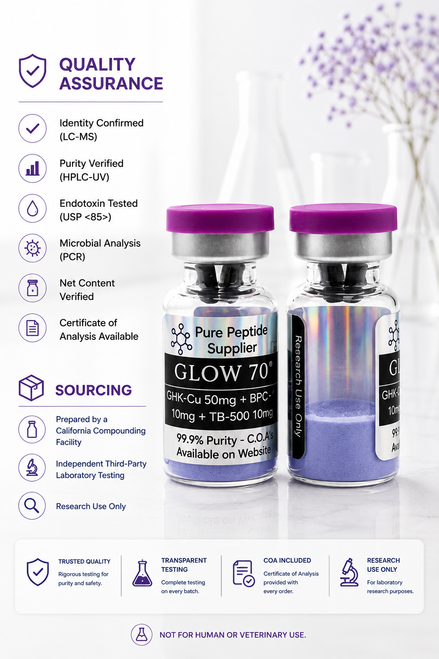
Glow Peptide Research Overview
Overview
Glow Peptide is a combination of three investigational peptides: GHK-Cu (glycyl-L-histidyl-L-lysine copper), TB-500 (a synthetic peptide derived from the active region of thymosin beta-4), and BPC-157 (Body Protection Compound-157). Although the combination itself has not been evaluated in controlled clinical studies, each component has been investigated independently in laboratory, animal, and, in some cases, human clinical research examining tissue biology, extracellular matrix remodeling, and cellular signaling.
Interest in combining these peptides is based on their distinct but potentially complementary biological mechanisms. Published research has investigated GHK-Cu for its role in extracellular matrix biology and connective tissue remodeling, TB-500 for its involvement in cytoskeletal dynamics and cellular migration, and BPC-157 for its potential effects on growth factor signaling, angiogenesis, and tissue physiology in experimental models.
Because these peptides influence different biological pathways, the combination has become a topic of interest within regenerative biology research. However, it is important to distinguish the published evidence supporting each individual peptide from evidence evaluating the combined formulation. At present, conclusions regarding the biological activity of the combination are derived primarily from mechanistic reasoning and independent studies rather than direct clinical investigation.
Mechanism of Action
GHK-Cu
GHK-Cu is an endogenous copper-binding tripeptide that has been extensively investigated for its role in extracellular matrix biology. Laboratory and human clinical studies have reported changes in collagen-related gene expression, elastin synthesis, glycosaminoglycan production, and extracellular matrix remodeling following exposure to GHK-Cu under specific experimental conditions.
Experimental investigations have also examined its role as a physiological copper carrier, supplying copper to enzymes involved in collagen cross-linking, antioxidant activity, and other cellular processes associated with connective tissue biology.
TB-500
TB-500 is a synthetic peptide derived from thymosin beta-4 and has been investigated primarily in laboratory and animal models. Published studies have reported effects on actin cytoskeletal dynamics, a fundamental process involved in cellular migration, tissue organization, and extracellular matrix remodeling.
Additional preclinical research has examined its influence on angiogenic signaling, inflammatory pathways, and connective tissue biology. These findings remain largely confined to experimental models, and controlled human clinical data are limited.
BPC-157
BPC-157 is a synthetic pentadecapeptide that has been investigated in numerous laboratory and animal studies examining tissue biology and cytoprotective mechanisms. Experimental research has reported modulation of growth factor signaling pathways, nitric oxide homeostasis, angiogenic activity, and inflammatory mediators under specific study conditions.
Most published findings involving BPC-157 originate from preclinical models evaluating tendon, ligament, muscle, gastrointestinal, vascular, and connective tissue physiology. Human clinical evidence remains comparatively limited.
Scientific Rationale
The scientific rationale for combining GHK-Cu, TB-500, and BPC-157 is based on their proposed influence on different aspects of cellular and extracellular matrix biology. Published research suggests that GHK-Cu has been investigated primarily in studies of extracellular matrix remodeling, TB-500 in studies of cytoskeletal organization and cellular migration, and BPC-157 in studies evaluating growth factor signaling, angiogenesis, and tissue physiology.
Although these complementary mechanisms provide a biological basis for continued investigation, there are currently no published randomized clinical trials evaluating the safety or biological effects of the combined formulation. Any discussion of potential synergy should therefore be interpreted as mechanistic hypothesis supported by independent peptide research rather than direct evidence from studies of the combination itself.
Summary
Glow Peptide represents an investigational multi-peptide research formulation composed of GHK-Cu, TB-500, and BPC-157. The biological rationale for the combination is derived from published laboratory, animal, and limited human research involving the individual peptide components. Additional controlled studies evaluating the combined formulation are necessary to further characterize its biological activity, pharmacology, and safety profile.