

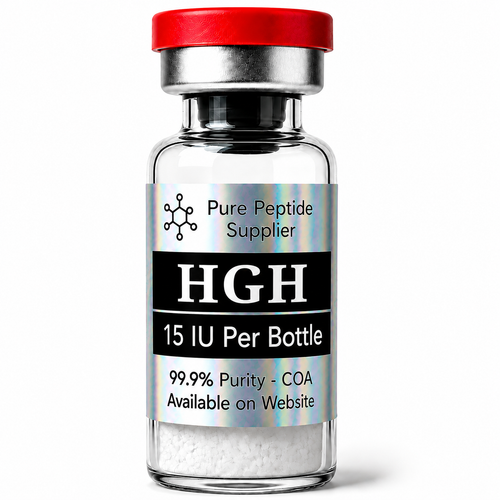
HGH 15IU Research Overview
Overview
Human Growth Hormone (HGH) is a 191-amino-acid peptide hormone endogenously produced by somatotroph cells in the anterior pituitary gland. It plays a central role in postnatal growth, metabolism, and body composition through direct actions on peripheral tissues and indirect effects mediated by insulin-like growth factor-1 (IGF-1), which is produced primarily in the liver in response to growth hormone stimulation.
Endogenous growth hormone secretion is pulsatile and regulated by the hypothalamic hormones growth hormone-releasing hormone (GHRH), which stimulates secretion, and somatostatin, which inhibits secretion. Additional regulatory inputs include ghrelin, sex steroids, nutritional status, exercise, sleep, and stress, all of which influence the pattern and magnitude of growth hormone release. The pulsatile nature of growth hormone secretion is important for its biological activity, as continuous exposure can lead to receptor downregulation.
Growth hormone exerts diverse physiological effects through its interaction with the growth hormone receptor. These include stimulation of linear growth in children, regulation of protein synthesis, enhancement of lipolysis, modulation of glucose metabolism, and influence on bone density and body composition. The effects of growth hormone on metabolism are complex, with both anabolic and catabolic actions depending on the target tissue and physiological context.
Growth hormone has been extensively investigated in clinical endocrinology for its approved indications, including growth hormone deficiency and certain conditions associated with short stature. Research has also examined its effects on aging, body composition, and metabolic function, although many of these applications remain investigational.
The 15IU designation refers to the International Units dosage of the reconstituted peptide, a standard measure of biological activity used in clinical and research settings. International Units are defined based on the biological activity of growth hormone in standard bioassays, with 1 IU corresponding to approximately 0.333 mg of the peptide.
Key Scientific Characteristics
191-amino-acid peptide hormone
Endogenously produced by somatotroph cells in the anterior pituitary
Regulated by GHRH, somatostatin, ghrelin, and other physiological inputs
Exerts effects through the growth hormone receptor and IGF-1 signaling
Investigated in clinical endocrinology and metabolic research
15IU formulations represent a specific dosage unit used in research contexts
Not approved for all potential research applications by the U.S. Food and Drug Administration
Research Notes
Human growth hormone has been extensively investigated in clinical and basic research. Its effects on growth, metabolism, and body composition have been characterized through decades of laboratory, animal, and human clinical studies. The 15IU designation refers to the International Units dosage, a standard measure of biological activity used in clinical and research settings.
Published clinical research has demonstrated the efficacy of growth hormone in its approved indications. Studies examining its use in other contexts, including aging and body composition research, have yielded variable results. Additional controlled trials are necessary to further characterize its potential applications and long-term safety profile.