

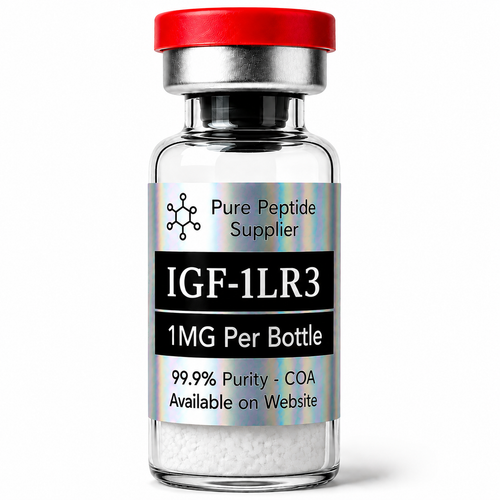
IGF-1LR3 1MG Research Overview
Overview
Insulin-like Growth Factor-1 Long R3 (IGF-1LR3) is a synthetic analog of endogenous insulin-like growth factor-1 (IGF-1) that has been engineered to prolong its biological activity and reduce binding to IGF-binding proteins. The standard 1mg concentration represents a common research dosage unit for investigations examining growth factor signaling and cellular proliferation.
The native IGF-1 molecule is a 70-amino-acid peptide that shares structural homology with insulin and functions as a key mediator of growth hormone action. It is produced primarily in the liver in response to growth hormone stimulation, although many tissues also exhibit local IGF-1 production. IGF-1 exerts its effects through activation of the IGF-1 receptor, a receptor tyrosine kinase that initiates downstream signaling cascades involved in cell growth, differentiation, and metabolism.
IGF-1LR3 is a modified analog in which an arginine (R) is substituted for glutamic acid (E) at position 3 of the peptide sequence, and the C-terminal region is elongated with 13 additional amino acids. These modifications reduce the peptide's binding affinity for IGF-binding proteins, thereby extending its circulating half-life and bioavailability compared with native IGF-1. This is a significant advantage in research settings, as endogenous IGF-binding proteins rapidly bind and sequester native IGF-1.
Laboratory investigations and animal studies have examined IGF-1LR3 for its effects on cell proliferation, muscle growth, tissue repair, and metabolic signaling. Research has explored its influence on protein synthesis, satellite cell activation, and regenerative capacity in skeletal muscle and other tissues. The peptide has been studied in various experimental models of tissue injury and repair.
The current body of evidence is derived primarily from preclinical research, with limited human clinical data available. Studies have reported effects on cell proliferation and protein synthesis under specific experimental conditions, although the translation of these findings to human physiology remains incompletely characterized.
Key Scientific Characteristics
Synthetic analog of endogenous insulin-like growth factor-1 (IGF-1)
Engineered with arginine substitution at position 3 and C-terminal elongation
Reduced binding affinity for IGF-binding proteins
Extended circulating half-life compared with native IGF-1
Investigated for effects on IGF-1 receptor signaling, cell proliferation, and tissue growth
Current evidence derived primarily from preclinical research
Not approved by the U.S. Food and Drug Administration for therapeutic use
Research Notes
IGF-1LR3 has been developed as a research tool for investigating the biological effects of IGF-1 receptor activation. Its modified structure reduces binding to IGF-binding proteins, which is a significant factor limiting the bioavailability of native IGF-1 in biological systems.
Additional research is needed to further characterize the pharmacology, safety profile, and physiological effects of IGF-1LR3 in human studies. Findings should be interpreted within the context of the specific experimental models and study designs employed.