

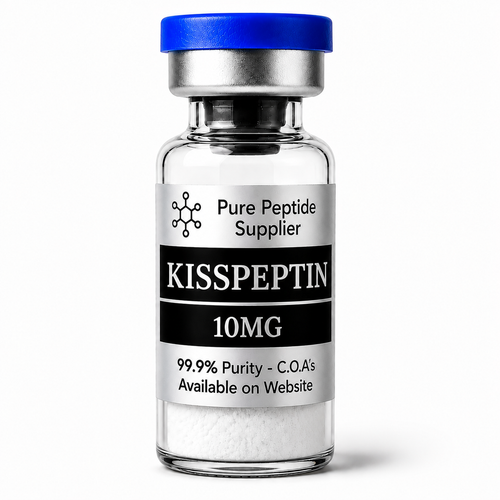
Kisspeptin Research Overview
Overview
Kisspeptin is a peptide hormone encoded by the KISS1 gene that plays a critical role in the regulation of the hypothalamic-pituitary-gonadal (HPG) axis. It acts primarily through activation of the G protein-coupled receptor GPR54 (also known as KISS1R) and functions as a key upstream regulator of gonadotropin-releasing hormone (GnRH) secretion. This places kisspeptin at the apex of the reproductive endocrine hierarchy.
The biological significance of kisspeptin was established through genetic studies demonstrating that loss-of-function mutations in KISS1 or its receptor result in hypogonadotropic hypogonadism and failure to undergo puberty. Conversely, activating mutations are associated with precocious puberty, confirming the peptide's essential role in reproductive maturation and function. These genetic findings established kisspeptin as a critical regulator of the reproductive axis.
Kisspeptin neurons are located in several brain regions, including the hypothalamus, and are regulated by sex steroids, metabolic signals, and environmental factors. The peptide's influence on GnRH secretion is mediated through its action on GnRH neurons, which express the kisspeptin receptor. This signaling pathway represents the primary mechanism through which kisspeptin regulates gonadotropin secretion and reproductive function.
Laboratory and clinical research has examined kisspeptin for its effects on reproductive physiology, including its potential role in fertility research, hypothalamic-pituitary-gonadal axis evaluation, and neuroendocrine investigation. Human studies have demonstrated that kisspeptin administration stimulates luteinizing hormone (LH) and follicle-stimulating hormone (FSH) secretion under controlled conditions.
Kisspeptin has also been investigated for its role in metabolic regulation, as kisspeptin neurons are sensitive to metabolic signals such as leptin and insulin. This relationship between reproduction and energy balance is mediated in part through kisspeptin signaling, providing a link between nutritional status and reproductive function.
Key Scientific Characteristics
Endogenous peptide hormone encoded by the KISS1 gene
Activates the GPR54 (KISS1R) receptor
Functions as a key upstream regulator of GnRH secretion
Essential for normal reproductive maturation and HPG axis function
Investigated for its role in reproductive physiology and endocrine research
Human clinical studies have demonstrated stimulation of gonadotropin secretion under controlled conditions
Also studied for its role in linking metabolic status to reproductive function
Not approved by the U.S. Food and Drug Administration for therapeutic use
Research Notes
Kisspeptin has been extensively investigated in reproductive endocrinology for its role in the regulation of the HPG axis. The discovery of its critical function in reproductive maturation has generated substantial interest in understanding its physiological and pathological significance.
Ongoing research continues to examine the neuroendocrine pathways through which kisspeptin regulates GnRH secretion, its interactions with other regulatory signals, and its potential research applications in reproductive physiology and endocrine investigation.