

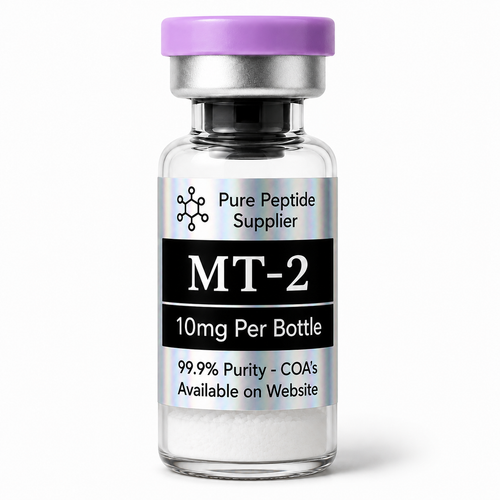
MT-2 (Melanotan II) Research Overview
Overview
Melanotan II (MT-2) is a synthetic cyclic peptide analog of alpha-melanocyte-stimulating hormone (α-MSH) that functions as a non-selective agonist at melanocortin receptors. It was developed as a research tool for investigating the physiological effects of melanocortin receptor activation, particularly with respect to melanogenesis, energy homeostasis, and sexual function.
MT-2 is a cyclic heptapeptide with the sequence Ac-Nle-cyclo[Asp-His-D-Phe-Arg-Trp-Lys]-NH₂. Its cyclic structure confers resistance to enzymatic degradation and enhances its receptor-binding characteristics compared with linear peptides. The peptide activates melanocortin receptors, primarily MC1R (involved in melanogenesis) and MC4R (involved in energy homeostasis and appetite regulation), but also shows activity at MC3R and MC5R.
Laboratory investigations and human clinical studies have examined MT-2 for its effects on skin pigmentation. Activation of MC1R stimulates melanin production through the cyclic AMP signaling pathway, resulting in increased pigmentation under specific experimental conditions. This effect has been the primary focus of research on MT-2, with studies examining the dose-response relationship, time course of pigmentation, and duration of effect.
Research has also investigated MT-2 for its effects on appetite and sexual function through MC4R and other melanocortin receptor subtypes. Activation of MC4R is known to suppress appetite, while activation of central melanocortin pathways has been implicated in the regulation of sexual function. These effects have been examined in both animal models and human studies.
Published clinical research has reported variable findings across different study populations and outcome measures. The effects of MT-2 on melanogenesis, appetite, and other melanocortin-mediated processes continue to be investigated, and the overall body of evidence is limited by the small number of controlled clinical trials.
Key Scientific Characteristics
Synthetic cyclic heptapeptide analog of α-MSH
Non-selective agonist at melanocortin receptors
Activates MC1R (melanogenesis) and MC4R (appetite, energy homeostasis)
Cyclic structure confers resistance to enzymatic degradation
Investigated for effects on skin pigmentation, appetite, and sexual function
Human clinical studies have been conducted with variable findings
Not approved by the U.S. Food and Drug Administration for therapeutic use
Research Notes
Melanotan II has been investigated in research contexts for its effects on melanocortin receptor signaling and physiology. Its activity at multiple receptor subtypes has made it a useful tool for studying melanocortin biology, although the interpretation of findings is complicated by its non-selective receptor binding.
Ongoing research continues to examine the pharmacological properties and biological effects of MT-2. Additional controlled clinical trials are necessary to further characterize its safety profile and physiological effects.