


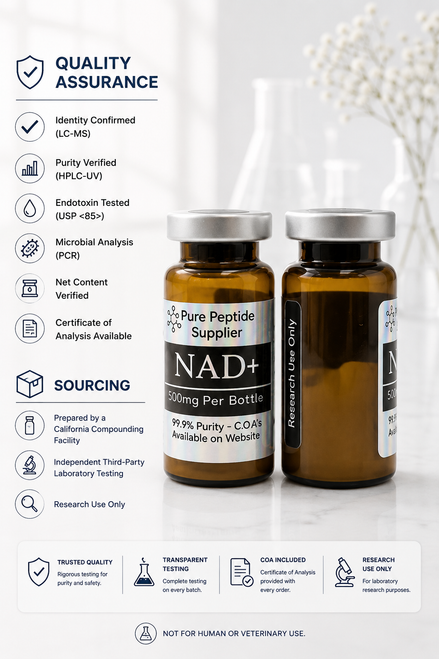
NAD+ (Nicotinamide Adenine Dinucleotide) Research Overview
Overview
Nicotinamide adenine dinucleotide (NAD+) is an endogenous coenzyme present in virtually all living cells and plays a central role in cellular metabolism. It exists in both oxidized (NAD+) and reduced (NADH) forms, continuously cycling between these states during oxidation-reduction (redox) reactions involved in ATP production and numerous metabolic processes.
In addition to its established role in cellular energy metabolism, NAD+ functions as a substrate for several enzyme families, including sirtuins, poly(ADP-ribose) polymerases (PARPs), CD38, and other NAD+-dependent proteins involved in DNA repair, cellular signaling, oxidative stress responses, and mitochondrial biology. Consequently, intracellular NAD+ availability has become an important area of investigation in molecular and cellular research.
Laboratory investigations and human observational studies have reported that NAD+ concentrations may decline with advancing age and under certain physiological or pathological conditions. These observations have prompted extensive research into the biological consequences of altered NAD+ metabolism and the mechanisms regulating intracellular NAD+ homeostasis.
Current research evaluating strategies to increase intracellular NAD+ includes precursor compounds such as nicotinamide riboside (NR) and nicotinamide mononucleotide (NMN), experimental parenteral NAD+ administration, and approaches designed to influence NAD+-consuming enzymatic pathways. These investigational approaches act through distinct biological mechanisms and remain the subject of ongoing laboratory and clinical research.
This monograph focuses primarily on injectable NAD+, which continues to be investigated in laboratory and human research settings. Published clinical data evaluating parenteral NAD+ remain limited compared with the larger body of literature examining oral NAD+ precursor compounds, and additional controlled studies are needed to further characterize its pharmacology, pharmacokinetics, and physiological effects.
Key Scientific Characteristics
- Endogenous coenzyme present in virtually all living cells
- Central component of cellular energy metabolism
- Participates in oxidation-reduction (redox) reactions involved in ATP production
- Serves as a substrate for sirtuins, PARPs, CD38, and other NAD+-dependent enzymes
- Intracellular concentrations have been investigated in relation to aging and metabolic physiology
- Active area of research within mitochondrial biology, cellular metabolism, and molecular physiology
- Injectable formulations remain investigational and are not approved by the U.S. Food and Drug Administration for therapeutic use
Research Notes
Current scientific literature extends well beyond NAD+'s established biochemical role in energy metabolism. Laboratory investigations, animal studies, and human clinical research continue to examine the relationship between intracellular NAD+ availability and mitochondrial function, genomic stability, oxidative stress, inflammatory signaling, and cellular adaptation.
Published clinical trials evaluating oral NAD+ precursor compounds have demonstrated measurable changes in circulating NAD+ metabolites under specific study conditions. In contrast, research involving injectable NAD+ remains comparatively limited and consists primarily of early-stage clinical investigations, observational studies, and pilot trials. Additional randomized controlled studies are required to further characterize the pharmacological properties and biological effects of parenteral NAD+ administration.