

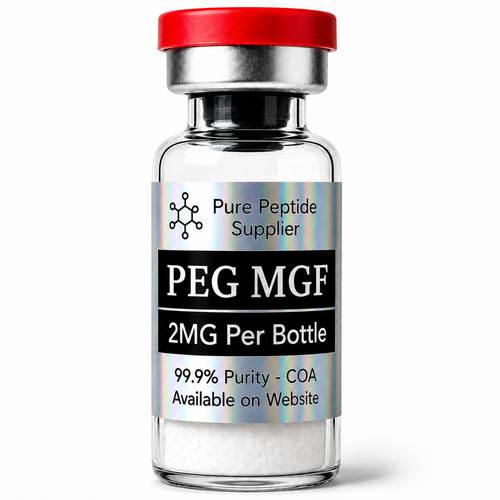
PEG MGF Research Overview
Overview
Pegylated Mechano Growth Factor (PEG MGF) is a synthetic peptide formulation that combines mechano growth factor (MGF), an isoform of insulin-like growth factor-1 (IGF-1), with polyethylene glycol (PEG) to extend its systemic half-life and bioavailability. The pegylation process involves covalent attachment of PEG polymers to the peptide, which reduces renal clearance and protects against enzymatic degradation.
MGF is a splice variant of IGF-1 that is produced in response to mechanical stimulation and tissue stress. It is characterized by a unique C-terminal extension that is not present in other IGF-1 isoforms. This extension confers distinct biological properties to MGF, including effects on satellite cell proliferation and tissue repair that may differ from those of systemic IGF-1.
MGF is believed to promote tissue growth and repair through mechanisms that may differ from those of systemic IGF-1, including activation of satellite cell proliferation in muscle tissue. The peptide's expression is upregulated in response to muscle damage and mechanical loading, suggesting a role in the adaptive response to tissue stress.
The pegylation of MGF is intended to prolong its biological activity, as the native peptide is rapidly cleared from circulation. PEGylation is a well-established technique for extending the half-life of peptide therapeutics, and it has been applied to MGF to enable sustained exposure in experimental systems.
Laboratory investigations and animal studies have examined PEG MGF for its effects on cellular proliferation, protein synthesis, and regenerative capacity in skeletal muscle and other tissues. Research has explored its potential to influence muscle growth and repair in various experimental models.
Key Scientific Characteristics
Synthetic peptide formulation combining MGF (IGF-1 splice variant) with PEG
Pegylation extends systemic half-life and bioavailability
MGF is produced in response to mechanical stimulation and tissue stress
Contains unique C-terminal extension not present in other IGF-1 isoforms
Investigated for effects on cellular proliferation, protein synthesis, and tissue repair
Current evidence derived primarily from preclinical research
Not approved by the U.S. Food and Drug Administration for therapeutic use
Research Notes
PEG MGF has been developed as a research tool for investigating the biological effects of mechano growth factor. Its pegylation is intended to overcome the rapid clearance of native MGF, allowing for extended exposure in experimental systems.
Additional research is needed to further characterize the pharmacology, safety profile, and physiological effects of PEG MGF. Ongoing studies continue to examine its potential applications in muscle biology and regenerative research.