

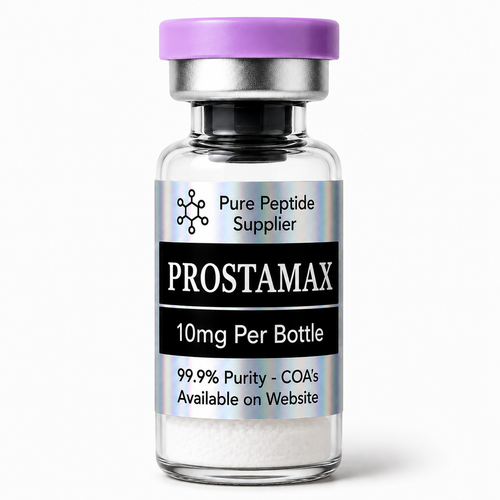
Prostamax Research Overview
Overview
Prostamax is a peptide formulation that has been investigated for its potential effects on cellular aging and prostate physiology. It is composed of specific peptide sequences that are believed to influence cellular signaling pathways involved in tissue maintenance, inflammatory responses, and age-related changes in prostate tissue.
The scientific rationale for Prostamax derives from research examining the role of peptide signaling in prostate health and cellular aging. Investigations have explored the effects of specific peptide sequences on cellular function, inflammatory mediators, and tissue homeostasis in experimental models. Research has focused on the potential of peptide signaling to influence age-related changes in prostate tissue.
Laboratory and animal studies have examined Prostamax for its effects on prostate physiology, including investigations into its potential influence on cellular turnover, inflammatory signaling, and tissue maintenance. Research has also explored its potential role in aging-related changes in prostate tissue, including cellular senescence and inflammatory processes.
The peptide sequences in Prostamax are believed to influence signaling pathways involved in the regulation of cellular proliferation, inflammation, and tissue remodeling. However, the precise molecular mechanisms through which these effects are mediated remain incompletely characterized and require further investigation.
The current body of evidence for Prostamax is derived primarily from preclinical research. Human clinical investigations remain limited, and the biological activity of the formulation has not been extensively characterized in controlled clinical settings.
Key Scientific Characteristics
Peptide formulation investigated for effects on cellular aging and prostate physiology
Composed of specific peptide sequences believed to influence cellular signaling
Research has examined effects on inflammatory signaling and tissue homeostasis
Current evidence derived primarily from laboratory investigations and animal studies
Human clinical research remains limited
Not approved by the U.S. Food and Drug Administration for therapeutic use
Research Notes
Prostamax has been investigated as a research tool for studying the effects of peptide signaling on prostate physiology and cellular aging. Its proposed effects on inflammatory mediators and tissue maintenance have been examined in preclinical models.
Additional research is necessary to further characterize the pharmacological properties, biological activity, and safety profile of Prostamax. Ongoing investigations continue to explore its potential applications in prostate biology and aging research.